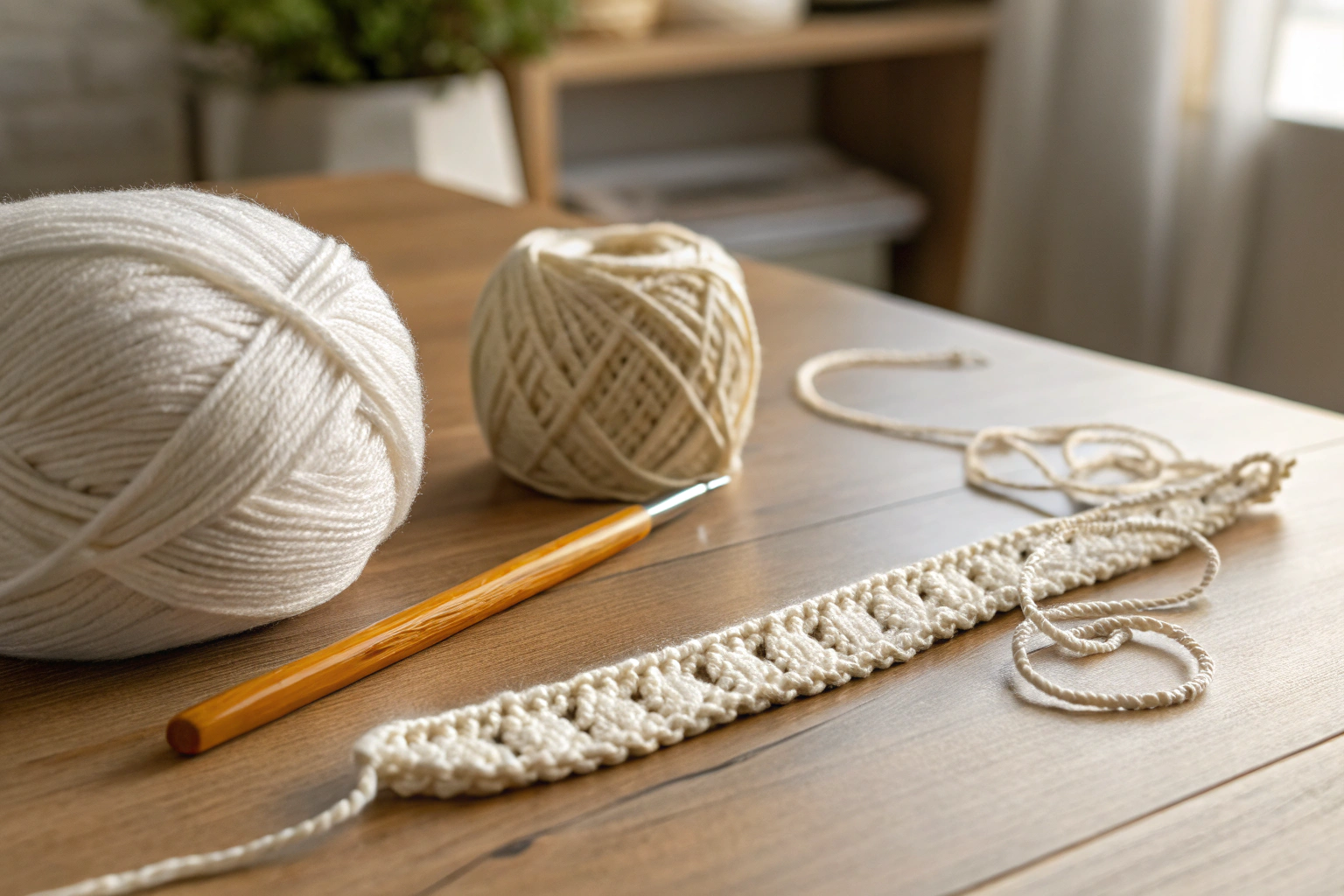
Learning how to start a crochet chain is the essential first step for any crochet project. This foundational row, made from a series of connected loops, determines the width of your work and provides a base for all subsequent stitches. A common challenge for beginners is maintaining consistent tension, which affects the neatness and final size of the piece. Mastering this simple technique unlocks the ability to create everything from blankets to clothing, making it the gateway to the craft.
Key Benefits at a Glance
- Creates a stable foundation: Your project starts straight and strong, preventing frustrating first-row issues and warping.
- Unlocks all patterns: This one simple skill is the gateway to making nearly any crochet item you can imagine.
- Gives you tension control: Mastering the chain helps you avoid a first row that is too tight or loose, ensuring your project lays flat.
- Builds project width quickly: You can rapidly create the base for scarves, blankets, and other flat pieces in just a few minutes.
- Functions as a design element: Use chains to create elegant spaces in lace patterns, simple ties for garments, or hanging loops.
Purpose of this guide
This guide is designed for absolute beginners who want to learn the fundamental building block of crochet. It solves the initial hurdle of getting started by breaking down the two key actions: making a slip knot and forming the chain stitch. You will learn the correct hand and yarn positioning step-by-step, providing a clear path to creating an even and consistent chain from your very first try. This guide helps you avoid common mistakes, like making loops too tight or uneven, which can ruin a project’s shape. Ultimately, you’ll gain the confidence to tackle your first real pattern.
Understanding why the chain stitch matters
Every crochet project begins with a single chain stitch, making this fundamental technique the gateway to the entire world of crochet. The crochet chain serves as the foundation row for virtually every pattern you’ll encounter, from simple dishcloths to intricate afghans. Without mastering this basic skill, progressing to more complex stitches becomes nearly impossible.
“According to recent surveys in 2025, over 93% of beginners successfully learn to crochet by first mastering the slip knot and chain stitches, which remain the universal foundation for most crochet projects.”
— Crochet Guild of America (crochet.org), September 2025
The chain stitches create the structural backbone that supports all subsequent rows of your work. Think of them as the concrete foundation of a house – if they’re uneven, too tight, or incorrectly counted, the entire project will suffer. This is why experienced crocheters often say that time spent perfecting your chain technique is never wasted.
Within the broader context of crochet, the chain stitch represents the most essential skill transfer point. Once you’ve mastered creating consistent, properly tensioned chains, you’ll find that learning other basic stitches becomes significantly easier. The muscle memory, hand positioning, and yarn control you develop while chaining directly applies to single crochet, double crochet, and beyond.
Essential materials and setting yourself up for success
Selecting the right crochet hook and yarn combination makes the difference between frustrating practice sessions and enjoyable learning experiences. For beginners learning to chain, I recommend starting with materials that offer forgiveness and visibility rather than focusing on the final project appearance.
The relationship between hook size and yarn weight directly impacts your chaining success. A size H/8 (5.0mm) hook paired with worsted weight yarn provides the ideal balance for most beginners. This combination creates chains large enough to see individual stitches clearly while maintaining enough structure to prevent excessive stretching or distortion.
| Hook Size | Yarn Weight | Best For | Beginner Friendly |
|---|---|---|---|
| H/8 (5.0mm) | Worsted Weight | Practice chains | Yes |
| I/9 (5.5mm) | Worsted Weight | Loose tension beginners | Yes |
| G/6 (4.0mm) | DK Weight | Tighter tension beginners | Moderate |
When choosing yarn for chain practice, prioritize light colors that contrast with your work surface. Acrylic yarn offers the best beginner experience due to its forgiving nature, consistent texture, and affordability. Unlike wool yarn, which can felt if handled roughly, or cotton yarn, which can be unforgiving with tension mistakes, acrylic maintains its structure while allowing easy correction of errors.
My recommended starter kit
After teaching hundreds of students, I’ve refined my essential supply list to include only items that directly contribute to chaining success. These recommendations focus on functionality over aesthetics, ensuring you can concentrate on technique development without equipment distractions.
- Size H/8 (5.0mm) crochet hook
- Worsted weight acrylic yarn in light color
- Scissors
- Yarn needle for weaving ends
- Stitch markers (optional but helpful)
Proper hand positioning for comfortable crocheting
Establishing correct hand positioning from the beginning prevents the development of tension problems and repetitive strain injuries that can plague crocheters for years. The way you hold your crochet hook and control yarn tension directly impacts both your comfort and the quality of your chains.
“In March 2024, the CDC noted, ‘Proper hand posture and tension when starting a crochet chain can help prevent wrist fatigue and repetitive strain injuries, especially among beginners new to yarn crafts.’”
— Centers for Disease Control and Prevention (cdc.gov), March 2024
Two primary grip styles dominate crochet instruction: the knife grip and pencil grip. Neither is inherently superior, but each offers distinct advantages depending on your natural hand mechanics and tension tendencies. The key lies in experimenting with both techniques to discover which feels more natural and sustainable for extended crocheting sessions.
| Grip Style | Pros | Cons | Best For |
|---|---|---|---|
| Knife Grip | More control, less hand fatigue | Slower initially | Tight tension, detailed work |
| Pencil Grip | Faster motion, familiar feel | Can cause hand strain | Loose tension, speed |
Yarn tension control involves your non-dominant hand and significantly impacts chain consistency. Proper tension allows the yarn to flow smoothly through your fingers while maintaining enough resistance to create uniform stitches. Too tight, and your hook struggles to move through loops; too loose, and your chains become sloppy and difficult to work into later.
Finding your comfortable grip
The search for your optimal grip style should prioritize long-term comfort over initial ease. Many beginners gravitate toward the pencil grip because it resembles familiar writing motions, but this can lead to hand cramping during extended sessions. Conversely, the knife grip may feel awkward initially but often proves more sustainable for longer projects.
Spend at least 15 minutes practicing chains with each grip style before making your decision. Pay attention to where tension develops in your hand, wrist, and forearm. The right grip should feel stable and controlled without requiring excessive muscle engagement.
Different ways to hold your crochet hook
The knife grip involves holding the crochet hook like a dinner knife, with your hand positioned over the hook and your thumb and index finger controlling the shaft. This grip provides excellent control for precise movements and reduces wrist strain by keeping your hand in a more natural position. Many professional crocheters prefer this method for detailed work requiring consistent tension.
The pencil grip positions the crochet hook between your thumb and index finger, similar to holding a writing instrument. Your middle finger provides support from underneath while your remaining fingers curl naturally. This grip often feels more familiar to beginners and can facilitate faster hook movements once muscle memory develops.
Creating your first slip knot and where it all begins
Every crochet chain starts with a slip knot, the crucial foundation that anchors your work to the crochet hook. This adjustable knot serves as the connection point between your yarn and hook while providing the stability needed for consistent chain creation. Understanding the slip knot’s role helps beginners appreciate why this seemingly simple step deserves careful attention.
Since every crochet project starts with a slip knot, it’s worth mastering it separately. You’ll find a detailed step by step tutorial here: How to Make a Crochet Slip Knot Easily.
The slip knot differs from regular knots because it can be adjusted and moved along the hook shaft as needed. This adjustability becomes essential as you develop consistent tension throughout your chaining process. A properly formed slip knot should slide smoothly on your hook without binding or loosening unexpectedly. To learn step-by-step techniques, consult the crochet basics article or view an official crochet tutorial.
The relationship between your slip knot, crochet hook, and yarn establishes the foundation for all subsequent chain stitches. When properly executed, the slip knot creates just enough resistance to maintain hook engagement while allowing smooth yarn flow during the chaining process.
Detailed slip knot techniques
Creating a reliable slip knot requires understanding the interaction between working yarn and yarn tails. The working yarn connects to your yarn ball and feeds through your fingers during chaining, while the yarn tail provides the adjustment mechanism for tightening or loosening the knot around your hook.
- Create a loop with yarn tail crossing over working yarn
- Pull working yarn through the loop to form a knot
- Insert hook through the loop
- Gently pull yarn tail to tighten around hook
- Test that knot slides easily on hook
The key to slip knot success lies in maintaining the correct relationship between working yarn and yarn tails. Your working yarn should move freely while the yarn tail provides adjustment control. If the knot binds on your hook, the yarn tail is too tight; if it slides off completely, more tension is needed.
Practice creating multiple slip knots until the motion becomes automatic. The muscle memory developed during this repetitive practice directly transfers to chain creation and establishes the foundation for consistent tension control throughout your crochet journey.
Step by step creating your chain stitches
The crochet chain represents the culmination of slip knot preparation, proper hand positioning, and controlled yarn movement. Each chain stitch builds upon the previous one through a repetitive process that, once mastered, becomes as automatic as walking. The key lies in understanding that every chain consists of the same basic yarn over motion executed with consistent tension and timing.
Creating reliable chain stitches requires coordination between your hook-holding hand and your yarn-controlling hand. Your dominant hand manipulates the crochet hook through the yarn over and pull-through motions, while your non-dominant hand maintains steady yarn flow and tension. This coordination develops gradually through practice and shouldn’t be rushed.
- Start with slip knot on hook
- Wrap yarn over hook from back to front
- Draw yarn through the loop on hook
- One chain stitch complete
- Repeat yarn over and pull through for each additional chain
The rhythm of chain creation becomes meditative once you establish consistent technique. Many crocheters find that counting aloud or maintaining a steady breathing pattern helps maintain uniform stitch size and tension throughout longer foundation chains.
Yarn over technique and the heart of chaining
The yarn over motion forms the core of virtually every crochet stitch, making its mastery essential for all future crochet success. This seemingly simple movement involves wrapping the yarn around your hook in a specific direction that ensures proper stitch formation and prevents twisted or malformed chains.
Once your chains feel comfortable, the next natural step is learning your first basic stitch. A great place to start is the half double crochet: Mastering the HDC Crochet Stitch.
- Always wrap yarn from back to front of hook
- Keep motion smooth and consistent
- Don’t twist the yarn during wrapping
- Maintain steady tension throughout the motion
The direction of your yarn over directly impacts stitch formation. Wrapping from back to front creates the standard orientation that allows easy hook insertion in subsequent rows. Wrapping in the wrong direction creates twisted stitches that are difficult to work into and can cause pattern distortion.
Practice the yarn over motion independently of chain creation initially. Focus on developing smooth, consistent wrapping that doesn’t twist or bind the yarn. This isolated practice builds muscle memory that transfers directly to full chain stitch execution.
Parts of a chain
Understanding chain anatomy helps with troubleshooting problems and prepares you for working stitches into your foundation chain later. Each chain stitch contains distinct parts that serve specific purposes in crochet construction, and recognizing these elements improves both your technique and your ability to follow written patterns.
The front loop appears as a V-shaped ridge on the side of your chain facing you as you work. This loop provides the most common insertion point for subsequent stitches and creates the standard appearance most patterns assume. The back loop mirrors the front loop on the opposite side of your chain and offers an alternative insertion point that creates different visual effects.
The back bump runs along the reverse side of your chain as a series of horizontal bars. Working into the back bump creates the smoothest, most professional-looking foundation row and is preferred by many experienced crocheters. However, it requires slightly more skill to execute consistently than front or back loop insertion.
Achieving perfect tension in your chain
Yarn tension control represents the most challenging aspect of chain creation for most beginners, yet it’s also the most critical for creating usable foundation rows. Inconsistent tension creates chains that are difficult to count, measure, and work into, leading to frustration and project abandonment. The relationship between yarn tension and crochet chain quality cannot be overstated.
Perfect tension allows your hook size to work optimally with your chosen yarn weight. Too tight, and your hook struggles to move through loops, creating stress on both your hands and your materials. Too loose, and your chains lack the structure needed to support subsequent rows of stitches. Finding the sweet spot requires practice and patience.
| Problem | Cause | Solution |
|---|---|---|
| Chains too tight | Excessive yarn tension | Relax grip, use larger hook |
| Chains too loose | Insufficient yarn tension | Increase grip pressure, smaller hook |
| Uneven chains | Inconsistent tension | Practice steady rhythm, count beats |
Environmental factors also influence yarn tension. Humidity affects yarn behavior, making it more or less slippery depending on conditions. Temperature changes can make your hands stiffer or more relaxed, altering your natural grip pressure. Recognizing these variables helps you adjust your technique accordingly.
Practice exercises for improving tension
Developing consistent yarn tension requires dedicated practice separate from project work. These exercises focus specifically on building muscle memory and awareness around tension control without the distraction of pattern following or stitch counting.
- Chain 20 stitches focusing only on consistent size
- Practice chaining while counting aloud to maintain rhythm
- Make chains with eyes closed to develop muscle memory
- Create chains of different lengths to build endurance
The most effective tension practice involves creating multiple sample chains under different conditions. Practice when you’re relaxed, when you’re tired, and when you’re distracted to understand how your mental state affects your physical tension control. This awareness translates directly to better project outcomes.
Counting and measuring your chain correctly
Accurate chain counting forms the foundation of successful pattern following and project sizing. The difference between counting methods can literally make or break a project, as patterns assume specific counting conventions that must be followed consistently. Understanding what counts as a chain versus what doesn’t eliminates one of the most common sources of beginner frustration.
The slip knot that starts your chain never counts as a stitch in your total count. Similarly, the working loop currently on your hook represents a work-in-progress rather than a completed stitch. These exclusions often confuse beginners who naturally want to count everything they see, but following this convention ensures pattern compatibility.
- Count each V-shaped chain stitch
- Do NOT count the slip knot
- Do NOT count the working loop on hook
- Count from bottom to top for accuracy
- Use stitch markers every 10 chains for long foundations
Proper counting technique involves identifying each distinct V-shaped chain formation along your foundation. These V’s represent completed stitches that can support subsequent rows of work. The consistent size and shape of these V’s also provides visual feedback about your tension consistency.
How to count your chains
Developing reliable counting skills prevents the frustration of discovering miscounts after completing several rows of a project. The V-shaped appearance of each chain provides the most reliable counting reference, as it remains visible regardless of tension variations or yarn type.
Start counting from the bottom of your chain, closest to your slip knot, and work upward toward your hook. This direction follows the natural progression of chain creation and reduces counting errors caused by visual confusion. Each V represents one chain stitch, regardless of size variations that might exist due to tension inconsistencies.
The working loop on your hook never counts as a completed chain, even though it may look similar to finished stitches. This loop represents potential energy – a stitch in progress rather than a completed element. Similarly, the slip knot serves as an anchor rather than a structural element, so it never contributes to your stitch count.
Troubleshooting common chain problems
Even experienced crocheters encounter crochet chain problems occasionally, so don’t feel discouraged when issues arise during your learning process. Most chain problems stem from tension inconsistencies, incorrect hook movements, or environmental factors that can be identified and corrected with systematic troubleshooting approaches.
Hook size mismatches with yarn weight create many common problems. A hook that’s too small for your yarn creates excessive resistance and tight stitches, while an oversized hook allows loose, sloppy chain formation. The yarn itself can also contribute to problems if it’s old, damaged, or unsuitable for your skill level.
| Problem | Quick Fix | Prevention |
|---|---|---|
| Twisted chains | Start over with proper yarn over | Always wrap back to front |
| Dropped stitches | Pick up with hook, continue | Maintain hook in working loop |
| Wrong count | Recount excluding slip knot | Mark every 10th chain |
Stitch markers prove invaluable for preventing and identifying counting errors before they become project-threatening problems. Placing a marker every 10 or 20 chains during foundation creation allows quick verification of your progress and makes recounting less tedious when corrections are needed.
When to start over vs when to fix
Making the decision to salvage or restart a crochet chain depends on several factors including the extent of problems, your skill level, and the intended use of your project. Generally, minor inconsistencies can be worked around, while major structural problems require starting fresh.
- DO start over if more than 25% of chains are problematic
- DO fix if only 1-2 chains are uneven
- DON’T continue with severely twisted chains
- DO practice the problematic technique before continuing
Consider the learning value when making restart decisions. Sometimes struggling through corrections teaches more about technique than starting over, while other times a fresh start with improved technique proves more educational. Trust your instincts about which approach will better serve your skill development.
Next steps and building on your chain foundation
Mastering the crochet chain opens the door to the entire world of crochet techniques and projects. Your chain skills directly transfer to basic stitches like single crochet, double crochet, and half double crochet, each of which builds upon the yarn over and pull-through motions you’ve already learned.
The transition from chains to basic stitches represents an exciting milestone in your crochet journey. The muscle memory, tension control, and hand coordination developed during chain practice provides the foundation for all future skill development. Most beginners find that their first successful basic stitches feel surprisingly familiar because of their chain practice.
Pattern reading becomes accessible once you’ve mastered chain creation and basic stitches. The abbreviations and instructions that seem mysterious initially begin making sense as your technical vocabulary expands. This progression from individual techniques to complete projects represents the true joy of crochet learning.
Simple projects to practice your chains
Selecting projects that emphasize chain work helps reinforce your new skills while creating useful items. These beginner-friendly options focus on chain techniques rather than complex stitch combinations, allowing continued practice without overwhelming technical demands.
- Bookmark using long chain with decorative ends
- Simple belt or tie using extra-long chain
- Coaster using chain formed into spiral
- Hair scrunchie using chain sewn into circle
As you move beyond simple chains and rows, colorwork quickly becomes exciting. When you’re ready to add stripes or patterns, read How to Switch Colors in Crochet for Seamless Patterns.
Each of these projects reinforces different aspects of chain technique while producing useful results that demonstrate your growing skills. The bookmark emphasizes consistent tension over length, while the spiral coaster introduces shaping concepts that will be useful for future projects.
Crocheting into a chain
Working your first stitches into a completed crochet chain foundation marks a significant milestone in your crochet education. This transition from creating chains to building upon them introduces new concepts like hook insertion, slip stitch techniques, and spatial awareness that expand your technical capabilities significantly.
The crochet hook insertion angle and depth determine both the ease of working and the final appearance of your project. Proper insertion creates stable stitches that support subsequent rows, while incorrect insertion can cause splitting, twisting, or loose connections that compromise structural integrity.
Stitch markers become particularly valuable when learning to work into chains, as they help identify insertion points and maintain consistent spacing. Many beginners find that marking the first and last chains of their foundation prevents confusion about where to start and end their first row of stitches.
Working into different parts of the chain
The anatomy of your chain offers multiple insertion options, each creating different visual and structural effects. Understanding these options expands your creative possibilities and helps you achieve specific design goals in your projects.
| Chain Part | Visual Effect | Difficulty | Common Use |
|---|---|---|---|
| Front loop only | Ridge on back | Easy | Decorative edge |
| Back loop only | Ridge on front | Easy | Foundation row |
| Back bump | Smooth appearance | Moderate | Professional finish |
Working into the front loop creates the most straightforward insertion experience for beginners, as these loops are clearly visible and easy to identify. The resulting ridge on the back of your work can be decorative or hidden depending on your project design. Back loop insertion creates a similar experience with the ridge appearing on the front side of your work.
The back bump technique requires slightly more skill to execute consistently but creates the most professional-looking foundation row. This method involves inserting your hook under the horizontal bars on the back of your chain, creating a smooth, seamless appearance that many experienced crocheters prefer for finished projects.
Frequently Asked Questions
To start a crochet chain step by step, first create a slip knot and place it on your crochet hook, then tighten it gently. Next, yarn over by wrapping the yarn from back to front over the hook and pull it through the loop on the hook to form the first chain stitch. Repeat the yarn over and pull through process for each additional chain, maintaining consistent tension for even stitches.
To make a slip knot for crochet, form a loop with the yarn tail crossing over the working yarn, leaving about 6 inches of tail. Insert your fingers through the loop, grab the working yarn, and pull it through to create a new loop, then place this loop on your crochet hook. Tighten the knot by pulling the working yarn while holding the tail, ensuring it’s adjustable but secure for starting your chain.
Tension is very important when starting a crochet chain because it determines the consistency and flexibility of your foundation stitches. Proper tension ensures that the chains are even, making it easier to work subsequent rows without distortion. If tension is too tight or too loose, it can affect the overall project size and make inserting the hook difficult in later steps.
To count chains in crochet, look at the top of the chain where each stitch forms a V shape, and count each V starting from the first one after the slip knot. Do not include the loop currently on your hook as part of the chain count. Turn the chain slightly to see the back bumps for verification if needed, ensuring accuracy for pattern requirements.
To hold the yarn properly for crocheting, wrap the working yarn around your pinky finger of the non-dominant hand, then under your ring and middle fingers, and over your index finger for tension control. Grip the crochet hook like a pencil or knife in your dominant hand, depending on comfort. This method helps maintain even tension and allows smooth yarn flow while chaining or stitching.