Knit ribbing is a textured stitch pattern created by alternating knit and purl stitches within a row, or from one row to the next. This technique produces a stretchy, reversible fabric that pulls inward, making it ideal for cuffs, hems, and necklines that need to fit snugly. A common concern for knitters is maintaining even tension to ensure the ribbing is neat and elastic without flaring out or appearing loose, which is key to a professional-looking finished object.
Key Benefits at a Glance
- Creates a Stretchy Fabric: Ribbing provides excellent elasticity and memory, making it perfect for areas that need to stretch and return to shape, like sweater cuffs and hat brims.
- Provides a Professional Finish: Using a ribbed edge gives garments a clean, polished, and store-bought appearance that elevates the look of your handmade items.
- Offers a Reversible Pattern: Basic ribbing patterns, like 1×1 or 2×2 rib, look the same on both the front and back, making them perfect for scarves, blankets, and dishcloths.
- Naturally Prevents Curling: Unlike stockinette stitch, which curls at the edges, ribbing lies flat, making it a functional and decorative choice for hems and borders.
- Enhances Garment Fit: The way ribbing pulls the fabric inward creates a closer, more tailored fit around the body, especially for waistbands and collars.
Purpose of this guide
This guide is for knitters of all skill levels who want to create neat, functional, and beautiful ribbing. It solves the common problems of loose stitches, uneven tension, and flared edges that can detract from a finished project. Here, you’ll learn how to choose the right ribbing pattern (like 1×1 or 2×2) for your project, cast on and bind off for maximum stretch, and troubleshoot common mistakes. By following these tips, you’ll be able to produce durable, elastic ribbing that provides a professional finish and ensures your handmade garments fit perfectly and last for years.
What is knit ribbing
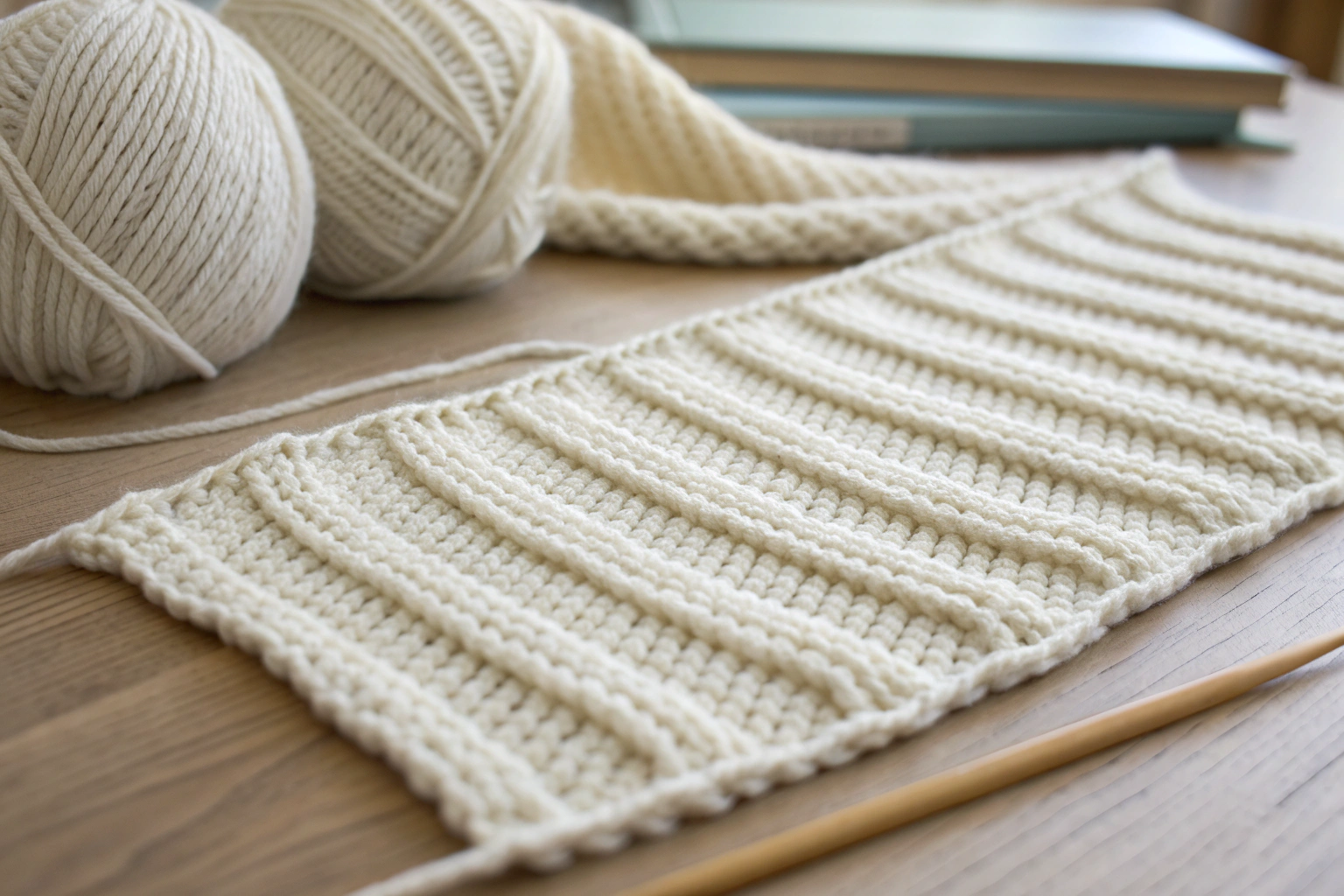
Knit ribbing represents one of the most fundamental and transformative techniques in the world of knitting. At its core, knit ribbing is a fabric structure created by alternating columns of knit and purl stitches, producing distinctive vertical ridges that give the technique its characteristic appearance and exceptional functionality. This alternating pattern creates an elastic fabric that can stretch significantly and then return to its original shape, making it indispensable for garment construction.
The magic of rib stitch lies in its structural brilliance. When you alternate knit and purl stitches in vertical columns, the fabric naturally contracts widthwise while maintaining its length. The knit columns form raised V shapes on the right side of the work, while the purl columns create valleys between them. This three-dimensional texture isn’t just visually appealing—it’s the key to ribbing’s remarkable elasticity and stretch recovery properties.
Early in my teaching career, I witnessed how mastering ribbing could completely transform a knitter’s confidence and project outcomes. The texture created by this simple alternation of stitches provides both functional and aesthetic benefits that make it essential for countless knitting projects. Unlike stockinette stitch, which curls naturally at the edges, ribbing creates a stable, non-curling edge that maintains its shape over time.
- Ribbing alternates knit and purl stitches to create vertical ridged texture
- Provides exceptional elasticity and stretch recovery li>Creates reversible fabric that won’t curl at edges
- Forms the foundation for most garment edges and decorative elements
Why ribbing matters in your knitting projects
Understanding why ribbing matters transforms how you approach every knitting project. Knit ribbing provides a textured surface that serves multiple critical functions beyond simple decoration. Whether worked in flat or circular knitting, ribbing creates the structural integrity that makes the difference between a professional-looking garment and an amateur attempt.
Ribbing is built entirely from knit and purl stitches, so a solid grasp of the basics makes it much easier. If you need a refresher, start with Knit vs Purl Explained with Easy Beginner Stitching Tips.
The philosophy I’ve developed through decades of design work centers on this truth: ribbing makes or breaks your project’s success. Elastic edges created through proper ribbing techniques ensure that cuffs, waistbands, collars, and edges of hats maintain their shape through countless wears and washes. Without this essential element, even the most beautiful stitch patterns can result in disappointing, poorly-fitting garments.
In my signature hat designs, I’ve seen how the right ribbing choice can solve fit problems that plague many knitters. A well-executed ribbing brim provides the perfect amount of stretch to accommodate different head sizes while maintaining the hat’s intended silhouette. This same principle applies to sweater cuffs, sock tops, and any garment edge that needs to perform under stress.
- Creates elastic edges that maintain shape over time
- Provides structural integrity at garment openings
- Adds decorative texture and visual interest
- Prevents fabric curling at cuffs, hems, and necklines
- Ensures comfortable fit through stretch and recovery
Basic ribbing patterns
My teaching approach to ribbing patterns emphasizes developing a natural rhythm that becomes second nature. Knit ribbing and rib stitch techniques form the foundation for countless variations, but mastering the basics requires understanding the relationship between knit and purl stitches and how they interact to create functional fabric. The key lies in knitting the knits and purling the purls as you see them in subsequent rows.
Patterns in ribbing follow logical sequences that become intuitive once you understand the underlying structure. Working with quality yarn that has good stitch definition makes learning these fundamentals much easier. The 1×1 rib stitch and 2×2 rib stitch represent the two most essential variations every knitter should master, as they form the basis for virtually all advanced ribbing techniques.
Through years of teaching, I’ve discovered that students who struggle with ribbing often lack confidence in reading their work. The rhythm of alternating stitches becomes natural when you learn to recognize the visual cues your knitting provides.
- Identify the repeat pattern (K1, P1 or K2, P2)
- Count total stitches needed for complete repeats
- Note any edge stitches outside the main repeat
- Check if pattern differs between right and wrong side rows
- Practice the rhythm before starting your project
1×1 rib stitch
The 1×1 rib stands as the ultimate expression of maximum elasticity in knitting. This single rib pattern, created through alternating knit purl stitches, provides 40-50% stretch that makes it ideal for applications requiring the highest degree of flexibility. Understanding how to work with both odd number of stitches and even number of stitches opens up design possibilities that can transform your projects.
1×1 rib stitch creates the tightest, most elastic fabric possible through ribbing techniques. The constant alternation between knit and purl creates maximum fabric contraction, resulting in exceptional stretch and recovery. This makes it perfect for narrow edges like sock cuffs, where you need the ribbing to grip securely without cutting off circulation.
In my signature hat designs, I’ve solved countless fit problems by strategically using 1×1 ribbing. Students often struggle with hats that are either too loose or too tight, but understanding the maximum elasticity properties of this rib pattern allows for perfect customization. The key technique I’ve developed for maintaining even tension involves keeping your yarn flow consistent during the knit-to-purl transitions.
- Cast on an odd number of stitches
- Row 1: *K1, P1* repeat to last stitch, K1
- Row 2: *P1, K1* repeat to last stitch, P1
- Repeat rows 1 and 2 for desired length
- Maintain consistent tension throughout
- Cast-on: Odd number of stitches
- Row pattern: K1, P1 alternating
- Elasticity: 40-50% stretch
- Best for: Sock cuffs, narrow edges, maximum stretch
2×2 rib stitch
2×2 rib represents the perfect balance between elasticity and stability in double ribbing applications. This pattern creates wider ridges that provide 30-40% stretch while maintaining structural integrity that’s essential for larger garment edges. Working with a multiple of 4 stitches creates the symmetrical flat ribbing pattern that professional designers rely on for sweater hems and hat brims.
The 2×2 rib stitch offers what I call balanced elasticity—enough stretch for comfort and fit, but with the stability needed for edges that must maintain their shape over time. This makes it my go-to choice for patterns that require both functional stretch and visual impact. The wider columns created by working two knitting stitches followed by two purl stitches create a more pronounced texture than 1×1 ribbing.
Professional project selection often comes down to understanding these elasticity differences. In my design portfolio, I showcase a cardigan where switching from 1×1 to 2×2 ribbing on the button bands solved a structural problem that had plagued the original design. The unique tip I share with students for maintaining even tension across wider columns involves adjusting your grip pressure rather than yarn tension when transitioning between stitch types.
- Cast on a multiple of 4 stitches
- Row 1: *K2, P2* repeat across row
- Row 2: *P2, K2* repeat across row
- Repeat rows 1 and 2 for desired length
- Keep wider columns evenly tensioned
- Cast-on: Multiple of 4 stitches
- Row pattern: K2, P2 alternating
- Elasticity: 30-40% stretch
- Best for: Sweater hems, hat brims, balanced stretch and stability
Other common ribbing variations
Beyond the fundamental 1×1 and 2×2 patterns, ribbing variations open up a world of creative possibilities that expand your design toolkit. Twisted rib and broken rib represent two particularly useful stitches that solve specific design challenges while offering different texture and stretch characteristics. These variations allow you to fine-tune the elasticity and visual impact of your ribbing to match project requirements.
My process for selecting ribbing variations involves analyzing both the functional and aesthetic needs of each project. A 3×3 rib provides moderate elasticity while creating bold vertical lines, perfect for statement edges on contemporary designs. The 2×1 asymmetrical variation offers high stretch with an interesting visual rhythm that works beautifully in modern knitwear.
Twisted rib became a game-changer in my professional work when I discovered its ability to create firm, well-defined edges with enhanced stitch clarity. Working the knit stitches through the back loop creates a subtle rope-like effect that’s less elastic than standard ribbing but provides superior stitch definition. Broken rib, while offering minimal stretch, creates fascinating textural interest that bridges the gap between functional ribbing and decorative stitch patterns.
| Pattern | Elasticity | Best Uses | Cast-on Multiple |
|---|---|---|---|
| 1×1 Rib | Maximum (40-50%) | Sock cuffs, narrow edges | Odd number |
| 2×2 Rib | Balanced (30-40%) | Sweater hems, hat brims | Multiple of 4 |
| 3×3 Rib | Moderate (25-35%) | Wide garment edges | Multiple of 6 |
| 2×1 Rib | High (35-45%) | Asymmetrical designs | Multiple of 3 |
| Twisted Rib | Firm (20-30%) | Structured edges, definition | Varies |
| Broken Rib | Low (15-25%) | Textural interest, less stretch | Varies |
- K = knit stitch
- P = purl stitch
- * * = repeat between asterisks
- Numbers indicate stitch count (K2 = knit 2 stitches)
- Twisted stitches worked through back loop for definition
Ribbing in the round
Working rib stitch in the round transforms the fundamental approach to ribbing construction, creating seamless edges perfect for hats, socks, and sweaters worked from the bottom up. Circular knitting modifies the basic ribbing approach by eliminating the need for alternating row patterns—instead, you simply knit the knits and purl the purls in every round. This requires careful attention to your cast-on count, ensuring you have an even number of stitches that creates complete multiples of your repeat.
When you work ribbing in the round, you’ll face the same challenges as any circular project: joins, ladders and tension. For more help, visit Knitting in the Round.
The beauty of circular knitting lies in its ability to create perfectly seamless ribbing edges. When working flat ribbing, you must alternate your pattern every row to maintain the vertical columns. In the round, the continuous spiral of knitting means you always see the right side of your work, making it easier to read your stitches and maintain consistent tension.
My techniques for seamless ribbing focus on the critical join and the first few rounds. Pattern adjustments become essential when converting flat ribbing patterns to circular construction. For example, a flat 2×2 ribbing that begins “K2, P2” on the right side will continue as “K2, P2” in every round when worked circularly, rather than alternating to “P2, K2” on wrong-side rows.
- No need to alternate row patterns – knit the knits, purl the purls every round
- Cast-on must be exact multiple of pattern repeat
- Place marker to track beginning of round
- Join carefully to avoid twisted stitches
- Maintain consistent tension at join point
- Calculate exact stitch count for your ribbing pattern
- Cast on using stretchy method suitable for ribbing
- Join in the round, being careful not to twist
- Place stitch marker at beginning of round
- Work ribbing pattern continuously without row variations
Essential techniques for perfect ribbing
Mastering ribbing requires attention to detail across multiple technical areas that work together to create professional results. My knitting philosophy emphasizes that perfect ribbing isn’t achieved through any single technique, but through the harmonious integration of proper gauge management, appropriate needle selection, and refined execution methods. Using smaller needles for ribbing creates the snugger fit that’s essential for functional edges.
Knitting needles, cast-on methods, and bind-off techniques each play crucial roles in achieving ribbing excellence. My teaching approach evolved through observing common mistakes that even experienced knitters make when working ribbing. The refined techniques I share often differ from conventional wisdom, having been developed through decades of problem-solving with students and perfecting methods for consistent results.
The technical foundation of great ribbing starts before you cast on your first stitch. Understanding how needle choice affects tension, how different cast-on methods impact edge elasticity, and how proper tension management creates even, elastic fabric transforms average ribbing into professional-quality results.
- Appropriate needle size (often one size smaller than body)
- Quality yarn with good stitch definition
- Stitch markers for pattern tracking
- Row counter for complex patterns
- Measuring tape for gauge checking
Tension management in ribbing
Achieving even ribbing requires mastering the art of maintaining consistent tension during knit-to-purl transitions, the most challenging aspect of ribbing for many knitters. Stitch consistency depends on understanding how yarn flow changes when switching between stitch types and developing techniques to minimize these variations. Whether you’re naturally a tight knitter or loose knitter, the principles of tension management can be adapted to your individual style.
My personal method for maintaining tension evolved from early career struggles with uneven ribbing that plagued my first professional designs. The breakthrough came when I realized that gauge consistency in ribbing requires different techniques than stockinette stitch. The constant switching between knit and purl stitches creates natural tension variations that must be consciously controlled.
The troubleshooting approaches I’ve developed with students focus on finger positioning and yarn flow rather than grip pressure. Many knitters try to solve tension problems by gripping their needles or yarn more tightly, which actually exacerbates the issue. Instead, maintaining steady yarn flow through consistent finger positioning creates the even stitch appearance that characterizes professional ribbing.
- Practice knit-to-purl transitions slowly and deliberately
- Keep yarn tension consistent when switching stitch types
- Use finger positioning to maintain steady yarn flow
- Check work frequently for even stitch appearance
- Adjust grip pressure rather than yarn tension for corrections
Choosing the right needles
Needle selection profoundly influences ribbing elasticity and definition, with knitting needles serving as the foundation for successful ribbing execution. The relationship between needle material, size, and ribbing performance became clear to me through decades of experimentation and teaching. Using smaller needles than your main fabric creates the density and structure essential for functional ribbing edges, while circular and straight needles each offer specific advantages depending on your project.
My needle preferences have been shaped by observing how different materials affect stitch formation and ease of knitting. The unexpected discovery that needle material significantly impacts elasticity came during a workshop where students using identical patterns and yarns achieved dramatically different results based solely on their needle choice. This led to my systematic approach to needle recommendations that considers both technical requirements and knitter comfort.
Knitting needles influence ribbing tension through their surface characteristics and flexibility. Bamboo needles provide gentle grip that helps maintain even tension, especially beneficial for beginners or when working with slippery yarns. Metal needles offer smooth, fast knitting ideal for experienced knitters, while wood needles provide warmth and comfort for extended ribbing sessions.
| Needle Type | Ribbing Impact | Best For | Considerations |
|---|---|---|---|
| Bamboo | Gentle grip, even tension | Beginners, slippery yarns | May snag delicate fibers |
| Metal | Smooth, fast knitting | Experienced knitters, speed | Can be slippery with some yarns |
| Wood | Warm feel, good grip | Natural fibers, comfort | Requires more care |
| Plastic | Lightweight, affordable | Practice, children | Less precise stitch formation |
- Choose needles one size smaller than body of garment for tighter ribbing
- Consider needle material based on yarn fiber and personal preference
- Circular needles work well for both flat and round ribbing
- Interchangeable tips allow easy size adjustments during project
Stretchy cast ons for ribbing
Cast-on methods fundamentally affect edge elasticity, making the choice of cast-on technique crucial for ribbing success. My preferred methods for ribbing prioritize maintaining the stretch characteristics that make ribbing functional while creating clean, professional-looking starts. The long-tail cast-on, Italian cast-on, and tubular cast-on each offer distinct advantages for different ribbing applications.
A stretchy cast on deserves a matching cast off, especially for cuffs, necklines and hems. Learn how to finish your ribbing beautifully in How to Cast Off Knitting for a Perfect Edge.
The importance of elastic edge construction became clear to me when a student’s beautiful sweater was ruined by a tight cast-on that prevented the ribbing from stretching properly. This experience led to my exploration of specialized cast-on methods and the development of my modified technique that combines the simplicity of long-tail with enhanced elasticity.
My favorite cast-on method for ribbing evolved through years of teaching and represents a refinement of traditional techniques. The story of how switching cast-on methods transformed a problematic project illustrates the dramatic impact that proper edge construction can have on finished garments. This modified approach ensures that your ribbing edge can stretch to match the fabric’s inherent elasticity.
- Leave a long tail (3-4 times the width of your cast-on edge)
- Create slip knot and place on needle
- Use long-tail method with extra wrap for elasticity
- Keep cast-on stitches loose but even
- Test stretch before proceeding with ribbing pattern
Frequently Asked Questions
Ribbing in knitting is achieved by alternating knit and purl stitches in a repeating pattern, such as knit 1, purl 1 for 1×1 ribbing or knit 2, purl 2 for 2×2. Start by casting on the required number of stitches and maintain the pattern across rows, knitting the knits and purling the purls to create the elastic texture. This method ensures the fabric stretches well for edges like cuffs and hems.
1×1 ribbing is tighter and more elastic, making it ideal for fitted areas like sock cuffs, while 2×2 ribbing offers a looser, more pronounced texture suitable for sweaters or hats. The better option depends on the project’s requirements, yarn weight, and desired stretch. Experiment with swatches to see which suits your knitting style best.
The tubular cast-on is widely regarded as the best for knit ribbing because it creates a seamless, stretchy edge that blends perfectly with the rib pattern. For simpler alternatives, the long-tail cast-on provides good elasticity and stability. Choose based on your skill level and the specific ribbing type for optimal results.
To bind off rib stitches properly, work in pattern by knitting the knit stitches and purling the purl stitches, then pass the previous stitch over each time. For added stretch, use a larger needle or try the tubular bind-off method to maintain elasticity. This technique ensures the edge matches the ribbing and doesn’t pull tight.
Ribbing is used in knitting projects for its natural elasticity, which helps prevent curling and provides a snug fit in areas like hems, cuffs, and necklines. It adds texture and structure to garments such as sweaters and socks. Overall, ribbing enhances both the functionality and aesthetic of knitted items.