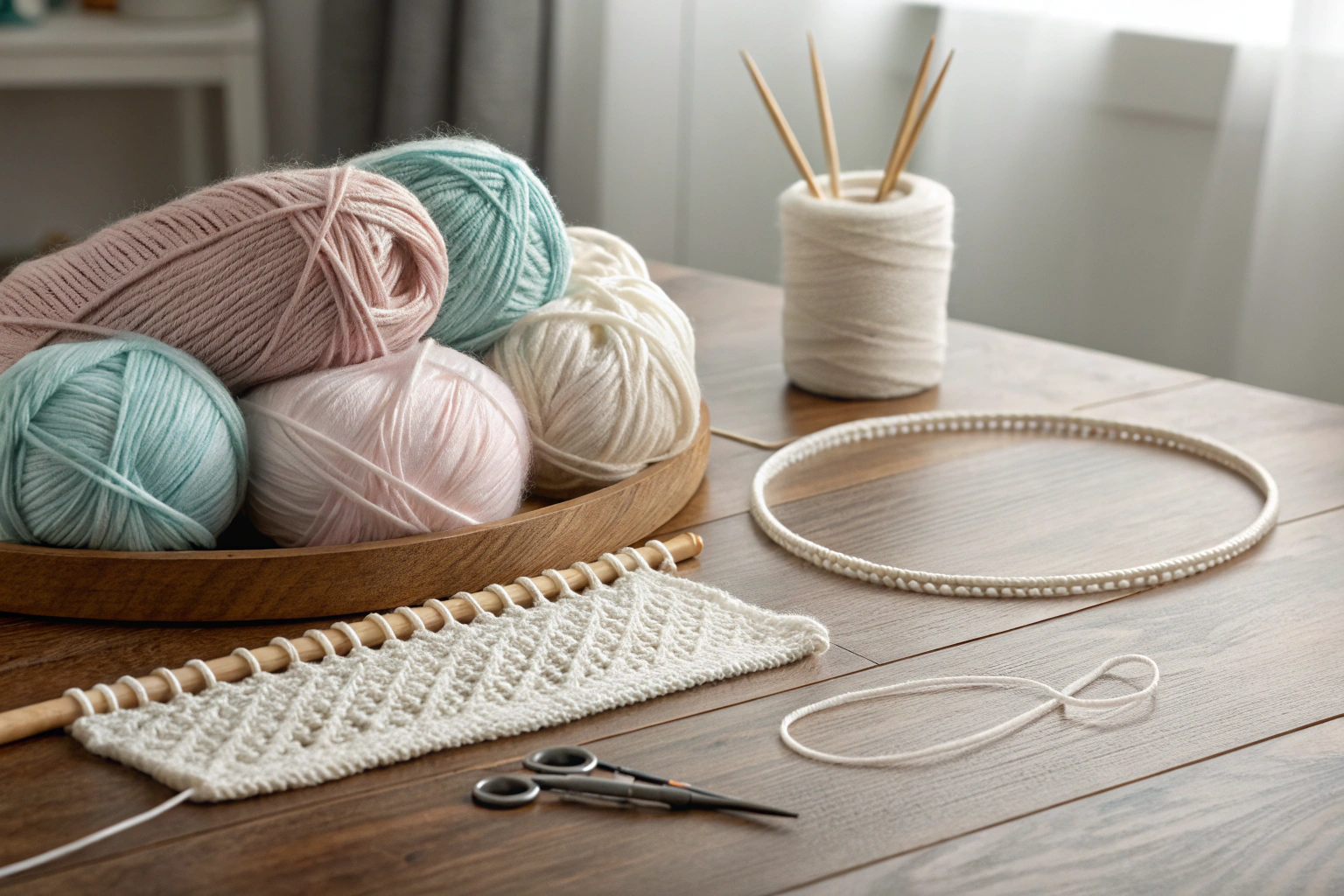
Knitting in the round is a technique used to create seamless, three-dimensional tubes of fabric, perfect for projects like hats, socks, and sweaters. Instead of knitting back and forth on straight needles, you join your stitches into a circle and knit continuously in one direction using circular or double-pointed needles (DPNs). A common concern for beginners is accidentally twisting the stitches when joining the round, which creates a permanent, unfixable twist in the finished item.
Key Benefits at a Glance
- Seamless Finish: Create professional-looking garments like hats and sweaters without any bulky or time-consuming seams to sew up later.
- Try It On As You Go: Easily slide your project onto your body or a form to check the fit and length, allowing for crucial adjustments before you finish.
- Faster Knitting: Working continuously in a spiral means you never have to stop to turn your work, resulting in a speedier and more rhythmic process.
- Improved Portability: Circular needles and DPNs are often more compact and easier to manage than long straight needles, making your projects perfect for on-the-go crafting.
- Consistent Stitch Tension: Since you are almost always knitting the “right side” of the fabric, it’s easier to maintain even tension and avoid the “rowing out” effect.
Purpose of this guide
This guide is for knitters who have learned the basics on straight needles and are ready to tackle their first seamless projects. It demystifies the process of knitting in the round, helping you move beyond flat scarves and blankets to create fitted garments and accessories. You will learn the essential steps to cast on and join your work without twisting, how to use circular and double-pointed needles, and how to spot and fix common mistakes. By following these tips, you will gain the confidence to create endless seamless items, opening up a new world of knitting patterns.
Understanding circular knitting basics and benefits
Circular knitting transforms the traditional back-and-forth motion of flat knitting into a continuous, seamless process that creates tubular fabric without any seaming required. This technique has revolutionized how knitters approach projects like hats, socks, and sweaters, eliminating the tedious finishing work that often intimidates beginners and challenges even experienced crafters.
- Circular knitting creates seamless, continuous fabric without seaming
- Projects maintain consistent tension throughout the work
- No side seams means better fit and professional appearance
- Ideal for hats, socks, sweaters, and tubular accessories
The beauty of circular knitting lies in its ability to produce professional-looking results with less finishing work. Instead of knitting flat pieces that require careful seaming, you create the final three-dimensional shape as you knit. This approach not only saves time but also creates stronger, more comfortable garments since there are no bulky seam allowances to irritate the skin or distort the fabric's drape.
What makes circular knitting different
The fundamental difference between circular and flat knitting extends beyond just the tools used. When knitting in the round, you're always working on the right side of your fabric, which means stockinette stitch requires only knit stitches rather than alternating knit and purl rows. This consistency makes many stitch patterns easier to execute and visualize as you work.
“Circular needles are meant to do what regular knitting needles cannot: knit a seamless round tube. While flat needles are great at knitting two-dimensional objects like squares and rectangles (think: scarves), circular needles are designed to knit three-dimensional tube-like things.”
— Sheep & Stitch, April 2024
Source link
| Aspect | Flat Knitting | Circular Knitting |
|---|---|---|
| Construction | Back and forth rows | Continuous rounds |
| Seaming | Required | None needed |
| Tools | Straight needles | Circular or DPN needles |
| Fabric | Stockinette requires purl rows | All knit stitches for stockinette |
The continuous nature of circular knitting also means your yarn tension remains more consistent throughout the project. There's no need to flip your work at the end of each row, which can sometimes cause tension variations that create uneven fabric. This consistency is particularly beneficial for colorwork patterns, where even slight tension changes can affect the overall appearance of the design.
Projects perfect for circular techniques
Certain project types showcase the advantages of circular knitting better than others. The seamless construction method excels when creating garments and accessories that benefit from continuous, uninterrupted fabric. Understanding which projects work best with circular techniques helps you choose the most efficient approach for your knitting goals.
- Hats and beanies – perfect seamless crown construction
- Socks – continuous tube from cuff to toe
- Sweater bodies – eliminate side seams entirely
- Cowls and infinity scarves – natural tube shape
- Mittens and gloves – seamless finger construction
- Baby items – soft, comfortable without bulky seams
Hats represent perhaps the most popular introduction to circular knitting because they're relatively quick projects that demonstrate the technique's benefits clearly. The seamless crown construction creates a professional appearance that's difficult to achieve with flat knitting methods. Similarly, socks knitted in the round eliminate the uncomfortable toe and heel seams that can cause blisters or pressure points.
For sweaters, circular knitting allows you to try on the garment as you work, ensuring proper fit before completing the project. This advantage becomes particularly valuable when knitting for others or when working with unfamiliar yarn weights that might affect the final measurements.
Understanding the mechanics why gaps and jogs occur
The spiral nature of circular knitting creates unique challenges that don't exist in flat knitting. While you're knitting in what appears to be perfect rounds, you're actually creating a continuous spiral that can cause visual disruptions, particularly noticeable in striped patterns or colorwork. For comprehensive background, the Wikipedia overview details essential techniques, while the Craftsy guide offers step-by-step instructions for beginners.
- Color changes create visible jogs due to spiral construction
- Stripe patterns show uneven edges without correction techniques
- Pattern repeats may appear misaligned at round beginnings
- Tension inconsistencies are more visible in circular work
The gap that often appears at the beginning of circular work results from the transition between the cast-on edge and the first round of knitting. This gap occurs because the cast-on stitches and the first knitted stitches have different structures and tensions. Understanding this mechanical reality helps you anticipate and prevent these issues rather than discovering them after completing significant portions of your project.
Jogs in colorwork happen because each "round" actually ends slightly higher than where it began, creating a step effect when you change colors. This spiral construction means that techniques for creating smooth color transitions require specific approaches that account for the three-dimensional nature of the work.
Essential tools for successful circular knitting
The success of any circular knitting project depends heavily on choosing appropriate tools for your specific project requirements. Unlike flat knitting, where needle selection primarily affects comfort and knitting speed, circular knitting tools directly impact your ability to execute the technique effectively. The relationship between tool selection and project success becomes particularly critical when working with different circumferences and stitch counts.
| Tool Type | Best For | Pros | Cons |
|---|---|---|---|
| Circular Needles | Large circumference projects | Comfortable, holds many stitches | Limited by cable length |
| Double-Pointed Needles | Small circumference items | Flexible for any size | Can create ladders, more complex |
| Magic Loop | Any size with long circular | One needle set for all projects | Requires technique mastery |
My personal toolkit has evolved over years of circular knitting experience, and I've learned that having the right tool for each project type makes the difference between enjoyable knitting and constant frustration. Quality needles with smooth joins between cable and needle tips prevent snagging and yarn splitting, while appropriate cable lengths ensure comfortable hand positioning throughout long knitting sessions.
The investment in proper circular knitting tools pays dividends in both knitting enjoyment and project quality. Cheap needles with rough cable joins or incorrectly sized cables can turn even simple projects into exercises in frustration. Understanding how each tool type functions helps you build a collection that supports your preferred project types.
Choosing the right needle for your project
Project circumference and stitch count determine the most effective needle choice for each circular knitting endeavor. The relationship between these factors isn't always intuitive, and many knitters struggle with needle selection until they understand the mechanical requirements of different project types.
- Hats: 16-inch circular or DPNs for crown decreases
- Adult socks: DPNs or 9-inch circular needles
- Baby items: DPNs or short circular needles
- Sweater bodies: 24-32 inch circular needles
- Sleeves: 16-inch circular or magic loop method
The general rule suggests that your circular needle cable should be shorter than your project's circumference to avoid stretching the stitches around the cable. However, this rule has exceptions, particularly when using the magic loop technique, which allows one long circular needle to work projects of any circumference.
For hat projects, I typically start with a 16-inch circular needle and switch to double-pointed needles when the crown decreases make the circumference too small for the circular needle. This approach provides the comfort of circular needles for the majority of the project while maintaining the flexibility needed for finishing techniques.
Using stitch markers effectively
Stitch markers serve as essential navigation tools in circular knitting, helping you track round beginnings, pattern repeats, and decrease points. The strategic placement of markers can prevent costly mistakes and make complex patterns much more manageable, particularly in projects with multiple pattern elements or shaping requirements.
Good stitch markers are key for tracking your rounds, but they also shine in flat knitting. For more ideas on using them well, see Stitch Markers for Knitting.
- Use a unique marker to identify the beginning of rounds
- Place markers between pattern repeats for easy counting
- Choose smooth markers that won’t snag delicate yarns
- Remove and replace markers when changing needle positions
The beginning-of-round marker becomes your anchor point for tracking progress and ensuring pattern alignment. I prefer using a distinctly different marker for this position—often a different color or style from the markers used elsewhere in the project. This visual distinction prevents confusion when working complex patterns that require multiple markers.
When working with double-pointed needles, markers need special consideration since they must transfer smoothly between needles without creating snags or tension issues. Removable markers work well for this situation, though they require more attention to prevent loss during needle changes.
Getting started casting on for circular projects
The foundation of successful circular knitting begins with proper cast-on technique and preparation for joining. Unlike flat knitting, where cast-on mistakes can be easily corrected by working a few rows and adjusting, circular knitting problems often require complete restarts if not caught immediately. This section establishes the groundwork for the critical joining phase that follows.
Selecting an appropriate cast-on method for circular work involves considering both the project requirements and the joining technique you plan to use. Some cast-on methods create edges that join more smoothly, while others provide specific stretch or appearance characteristics that benefit certain project types.
Best cast on methods for circular work
Different cast-on methods provide varying levels of stretch, appearance, and compatibility with circular joining techniques. Understanding these characteristics helps you choose the method that best supports your specific project requirements and personal knitting style preferences.
Once you’ve cast on successfully, a smooth bind off is just as important for a professional finish. You can review essential cast off techniques in How to Cast Off Knitting for a Perfect Edge.
| Cast-On Method | Stretch | Appearance | Best For |
|---|---|---|---|
| Long-tail | Good | Clean edge | Most projects |
| Tubular | Excellent | Professional | Ribbed edges |
| Backward loop | Poor | Loose | Emergency only |
| Cable | Minimal | Firm edge | Structured items |
The long-tail cast-on remains my preferred method for most circular projects because it provides good stretch while creating a clean, professional-looking edge that joins smoothly. The built-in elasticity accommodates the slight stretching that occurs during joining without creating loose or tight spots in the finished edge.
For projects beginning with ribbing, particularly sock cuffs or hat brims, tubular cast-on creates an incredibly professional appearance that seamlessly blends with the ribbed fabric. While this method requires more initial setup time, the superior appearance justifies the extra effort for visible project edges.
Ensuring your stitches aren't twisted
Preventing twisted cast-on stitches represents one of the most critical steps in circular knitting preparation. A twisted cast-on creates a Möbius strip effect that cannot be corrected without completely restarting the project. This verification step requires careful attention but prevents hours of wasted knitting time.
- Lay work flat on table with needles parallel
- Check that all cast-on loops face the same direction
- Verify the cast-on edge forms a straight line
- Look for any twisted loops before joining
The verification process becomes more challenging with double-pointed needles since the stitches are distributed across multiple needles. I recommend arranging the needles in a triangle or square formation and checking each needle section individually before attempting to join. Taking time for this verification prevents the frustration of discovering a twist after completing significant portions of your project.
Some knitters find it helpful to knit one or two rows flat before joining to make twist detection easier. While this approach requires seaming the flat section later, it provides additional security against the twisted join problem that plagues many circular knitting attempts.
The critical join mastering the start of circular knitting
The joining process represents the make-or-break moment in circular knitting, where proper technique prevents gaps, twists, and tension problems that can compromise the entire project. This critical transition from linear cast-on to circular construction requires specific techniques developed through years of practice and refinement.
- Place beginning-of-round marker on right needle
- Hold working yarn firmly but not too tight
- Insert right needle into first cast-on stitch
- Knit first stitch snugly to close the gap
- Continue knitting around, maintaining even tension
The moment of joining creates a connection point that will be visible throughout the life of your project, making proper execution essential for professional results. The working yarn position and tension during this critical first stitch determine whether you'll have a clean join or a noticeable gap that requires later correction.
My approach to joining has evolved through countless projects and teaching experiences. The key insight involves understanding that the join isn't just about connecting the first and last cast-on stitches—it's about creating a smooth transition that maintains the fabric's structural integrity while preventing the common problems that plague circular knitting beginners.
Three foolproof joining techniques I swear by
Different joining situations call for specific techniques, and having multiple approaches in your skill set ensures success regardless of yarn type, needle configuration, or project requirements. These three methods represent my go-to solutions for various circular knitting scenarios.
| Technique | Difficulty | Gap Prevention | When to Use |
|---|---|---|---|
| Standard Join | Easy | Good | Most projects |
| Backward Loop Join | Medium | Excellent | Visible join areas |
| Cable Cast-On Join | Advanced | Superior | Professional finish needed |
The standard join works well for most projects and involves simply knitting into the first cast-on stitch with careful attention to tension. This straightforward approach succeeds when you maintain consistent yarn tension and use the cast-on tail strategically to minimize gaps.
For projects where the join will be highly visible or when working with yarns that tend to create gaps, the backward loop join provides superior gap prevention by creating an additional connection point between the last and first stitches. This technique requires removing the backward loop on subsequent rounds but creates virtually invisible joins.
Preventing the dreaded gap my tension tricks
Gap formation at the join point represents the most common problem in circular knitting, and preventing these gaps requires specific tension management techniques that differ from normal knitting practices. Understanding the mechanical causes of gap formation enables targeted solutions that address the root problem rather than just treating symptoms.
- Knit the first few stitches slightly tighter than normal
- Leave a 6-inch tail for weaving in and gap closure
- Use the tail to manually close any small gaps
- Practice consistent yarn tension throughout the project
The cast-on tail becomes a valuable tool for gap prevention when used strategically during the joining process. Rather than simply leaving it to weave in later, I use the tail to manually adjust the join tension, pulling it gently to close any gaps that appear during the first few rounds of knitting.
Tension management during joining requires a delicate balance—too tight creates puckering and distortion, while too loose leaves visible gaps. The key involves maintaining slightly increased tension for the first three or four stitches after joining, then returning to normal tension for the remainder of the round.
Flat to round joining after knitting a few rows flat
This alternative joining technique provides an excellent solution for preventing twists while creating clean, professional joins. The method involves knitting several rows flat before joining, which makes twist detection much easier while providing additional security against joining problems.
- Cast on and knit 4-6 rows flat in stockinette
- Place stitches on circular needle without twisting
- Join for circular knitting at row beginning
- Seam the flat section closed with mattress stitch
This approach works particularly well for beginning knitters who struggle with twist detection or for projects using yarns that make twist identification difficult. The flat section provides a clear visual reference for proper stitch orientation while creating a stable foundation for the circular join.
The seaming step requires careful attention to maintain the fabric's stretch characteristics, but mattress stitch creates nearly invisible seams when executed properly. This technique trades a small amount of additional finishing work for significantly increased joining security and success rates.
Essential circular knitting techniques for professional results
Beyond the initial joining challenge, maintaining professional quality throughout circular projects requires mastery of specific techniques that address the unique characteristics of round knitting. These techniques build upon the foundation established during joining and ensure consistent, high-quality results throughout your project.
“The most significant advantage of using a knitting machine is how much time you save compared to hand-knitting. With a knitting machine, projects that would take days or weeks by hand can be completed in just a few hours.”
— Hooks & Needles, June 2024
Source link
While this discusses machine knitting, the time-saving principle applies when mastering circular techniques versus seaming flat pieces. The efficiency gains from circular knitting become apparent once you master the essential techniques that prevent common problems and maintain consistent fabric quality.
Professional results in circular knitting stem from understanding how the continuous round construction affects yarn behavior, stitch formation, and overall fabric characteristics. These insights inform technique choices that prevent problems before they occur rather than requiring corrections after completion.
Managing tension throughout your project
Consistent tension management in circular knitting requires different strategies than flat knitting due to the continuous nature of the work and the lack of row-end tension resets. Understanding these differences enables proactive tension control that maintains even fabric throughout long projects.
Circular projects often combine ribbing and color changes, both of which affect your overall tension. If you’re planning striped hats or cuffs, take a look at How to Change Colors in Knitting.
- Maintain consistent yarn position in your dominant hand
- Take breaks to prevent hand fatigue affecting tension
- Check gauge periodically throughout long projects
- Adjust needle grip if stitches become too tight or loose
The continuous nature of circular knitting means that tension inconsistencies become more apparent than in flat knitting, where row-end adjustments can mask minor variations. Developing awareness of your personal tension patterns helps you anticipate and prevent problems before they become visible in the finished fabric.
Hand position consistency becomes particularly important during long knitting sessions, as fatigue-induced changes in grip or yarn handling can create visible tension variations. Regular breaks and conscious attention to hand positioning maintain the consistent tension that characterizes professional-quality circular knitting.
Eliminating ladders between needles
Ladder formation between double-pointed needles represents a common challenge that can compromise the appearance of otherwise well-executed circular projects. Understanding the mechanical causes of ladders enables targeted prevention strategies that maintain even fabric across needle transitions.
- Pull working yarn snug when moving between needles
- Knit first stitch on new needle with extra tension
- Redistribute stitches frequently to prevent stretching
- Consider switching to magic loop for problem areas
Ladders form when the yarn span between needles creates loose stitches at the transition points. This problem becomes more pronounced with slippery yarns or when needle spacing increases due to stitch distribution changes during knitting. Prevention requires conscious attention to yarn tension during needle transitions.
Regular stitch redistribution prevents the gradual stitch migration that contributes to ladder formation. I recommend adjusting stitch positions every few rounds, ensuring that needles don't become overcrowded or sparse, which affects the yarn path between needles and contributes to uneven tension.
Troubleshooting common circular knitting problems
Even experienced circular knitters encounter problems that require troubleshooting skills and corrective techniques. Understanding common issues and their solutions enables quick problem resolution without project abandonment, saving time and maintaining knitting momentum.
| Problem | Quick Fix | Long-term Solution |
|---|---|---|
| Twisted join | Drop down and reknit | Start over if extensive |
| Large gap at join | Tighten with tail | Adjust joining technique |
| Ladders on DPNs | Redistribute stitches | Switch to circular needles |
| Uneven tension | Block finished piece | Practice consistent technique |
Problem identification skills develop through experience, but understanding the common issues helps you recognize problems early when correction is still feasible. Many circular knitting problems can be prevented through proper technique, but when issues do arise, having multiple correction strategies prevents project abandonment.
The decision between quick fixes and complete restart depends on problem severity, project stage, and personal tolerance for imperfections. Some problems that seem catastrophic have simple solutions, while others that appear minor may require extensive correction work to achieve professional results.
Rescuing a twisted join my emergency fix
Discovering a twisted join after completing several rounds doesn't necessarily require starting over completely. This emergency fix technique can save projects when the twist is localized and the amount of completed work makes restart impractical.
- Identify the exact location of the twist
- Drop stitches down to the twisted join point
- Untwist the cast-on edge carefully
- Pick up dropped stitches in correct order
- Continue knitting with proper alignment
This rescue technique works best when the twist is discovered within the first inch of knitting and when working with yarns that don't felt or stick together easily. The success rate depends on your skill with dropping and picking up stitches, but it's worth attempting before abandoning significant amounts of completed work.
The key to successful twist rescue involves careful stitch tracking during the correction process. Using lifelines or stitch markers helps maintain proper stitch orientation while working through the correction, preventing additional problems during the rescue attempt.
Alternative fix grafting to close gaps after joining
When gaps appear at the join despite careful technique, grafting provides an elegant solution that maintains the fabric's stretch characteristics while creating invisible repairs. This technique works particularly well for gaps that are too large for simple tail-tightening methods.
- Thread cast-on tail onto tapestry needle
- Insert needle through base of first knit stitch
- Weave through cast-on edge to close gap
- Secure tail on wrong side of work
Grafting for gap closure requires understanding the stitch structure at the join point and matching the grafting path to the natural yarn flow. This technique creates repairs that are virtually indistinguishable from perfect joins when executed properly, making it valuable for high-visibility projects or when working with expensive yarns where restart isn't desirable.
The success of grafting repairs depends on matching the original stitch tension and path, which requires practice and understanding of knitted fabric structure. However, this skill proves valuable for various knitting repairs beyond just circular join problems, making it a worthwhile technique to master.
Frequently Asked Questions
Knitting in the round involves using circular or double-pointed needles to create seamless tubes of fabric, such as for hats or socks. Start by casting on stitches onto the circular needle, then join the ends by knitting the first and last stitches together while ensuring the stitches aren’t twisted. Continue knitting each round without turning the work, marking the beginning with a stitch marker for easy tracking.
A gap or jog often occurs in knitting in the round due to uneven tension when joining the cast-on stitches or switching colors in striped patterns. This happens because the first and last stitches don’t align perfectly in a spiral formation. To minimize it, techniques like slipping stitches or using jogless joins can create a smoother transition.
To avoid twisting stitches in knitting in the round, lay your cast-on stitches flat on a surface before joining and ensure they form a straight line without loops or crosses. Double-check the orientation by tracing the cable or needles around the circle. If using double-pointed needles, distribute stitches evenly and join carefully to prevent any twists.
Magic loop is a technique for knitting in the round using a long circular needle to handle small circumferences, like sleeves or socks, by looping the cable to divide stitches into two sections. Traditional knitting in the round can use shorter circulars or double-pointed needles for the same purpose without looping. Magic loop offers flexibility for various project sizes with one needle.
Circular needles with a flexible cable are ideal for most knitting in the round projects, available in various lengths to match the project’s circumference. Double-pointed needles work well for small items like socks or gloves, allowing stitches to be distributed across multiple needles. Choose needle material based on yarn type—metal for slippery yarns and wood for grippy ones—to ensure smooth knitting.