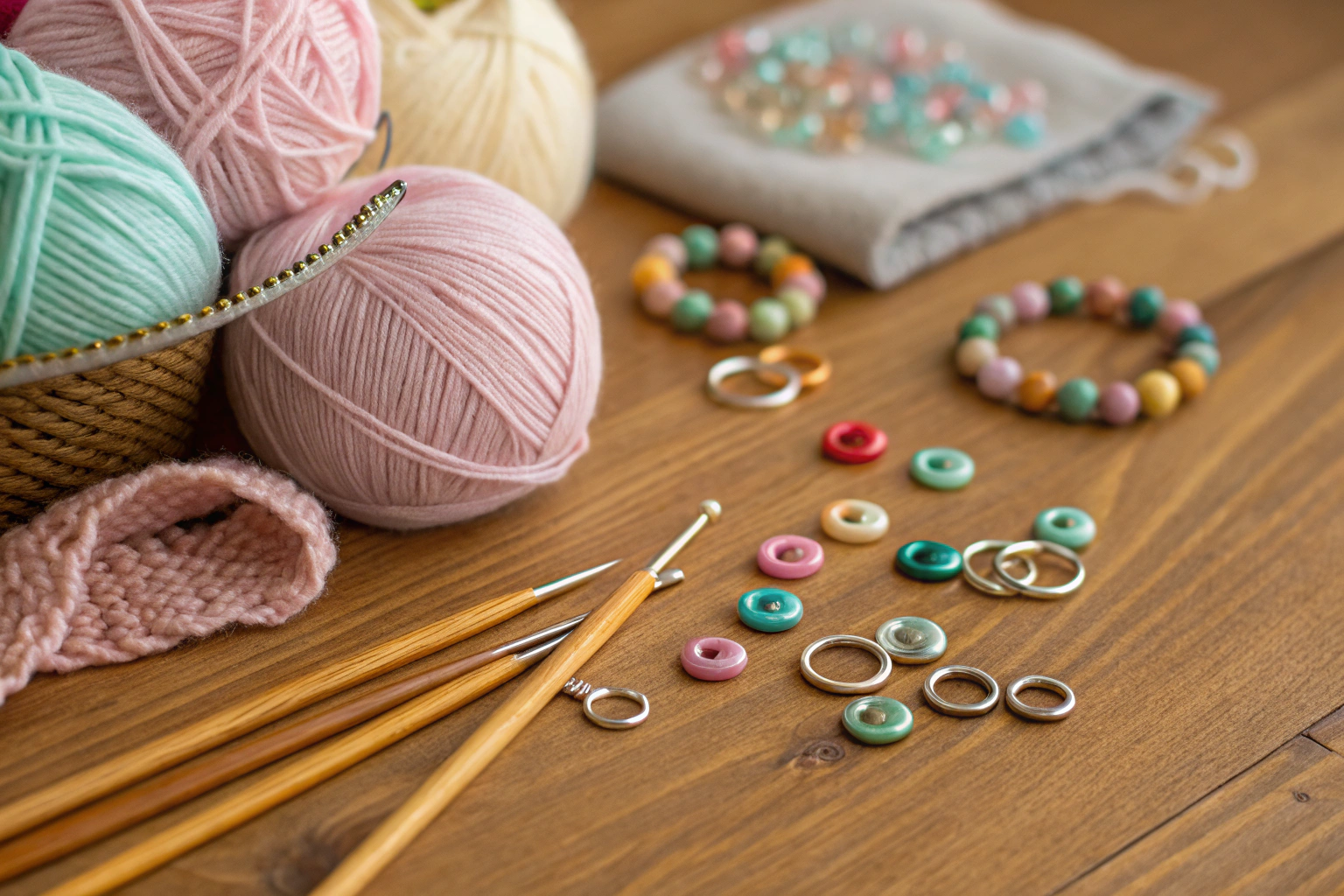
Stitch markers for knitting are small, essential tools used to mark a specific spot in your work, such as the beginning of a round or a pattern repeat. They slip onto your knitting needles or attach directly to a stitch, acting as a visual cue to perform an action like an increase, decrease, or cable twist. Using them helps prevent common mistakes, saving you from the frustration of having to unravel your project to fix an error. They are indispensable for keeping your place and ensuring accuracy.
Key Benefits at a Glance
- Increased Accuracy: Avoid costly mistakes by precisely tracking pattern repeats, lace sections, or the start of a round.
- Faster Knitting: Work with more confidence and speed, as you no longer need to constantly stop and recount your stitches.
- Tackle Complex Patterns: Easily manage intricate designs like lacework or cables by breaking them down into smaller, marked sections.
- Simplified Error-Fixing: Quickly identify where a mistake was made, making it much easier to correct errors without unraveling large portions of your work.
- Versatile and Affordable: Choose from many types, including locking and ring markers, or even use a simple loop of scrap yarn for a no-cost option.
Purpose of this guide
This guide is designed for knitters of all skill levels, especially those new to circular knitting or complex patterns. It solves the common problem of losing your place, miscounting stitches, and feeling overwhelmed by intricate instructions. You will learn the difference between locking and ring markers, how to place them correctly on your needles or in your fabric, and simple techniques to use them effectively. We’ll cover how to avoid common mistakes, like accidentally knitting your marker into the work, ensuring your projects turn out beautifully every time.
Introduction
After two decades of knitting and teaching countless students, I've discovered that the smallest tools often make the biggest difference. Stitch markers—those simple rings and clips that seem so basic—have the power to transform your knitting from frustrating guesswork into confident, precise craftsmanship. Whether you're wrestling with your first cable pattern or tackling an intricate lace shawl, the right stitch markers can be the difference between knitting success and a pile of frogged yarn.
Understanding stitch markers: the foundation of precise knitting
I'll never forget the moment stitch markers clicked for me. I was struggling through my third attempt at a complex Fair Isle sweater, constantly losing my place in the colorwork pattern and making costly mistakes that required hours of tinking back. A fellow knitter at my local yarn shop suggested I try using stitch markers to separate each pattern repeat, and suddenly everything changed. What had been an exercise in frustration became manageable, even enjoyable.
Stitch markers are small, removable tools designed to mark specific points in your knitting. They slip onto your needles or clip onto individual stitches, serving as visual anchors that help you track your progress, maintain pattern accuracy, and prevent errors. These humble accessories have evolved from simple safety pins and yarn scraps into sophisticated tools that can elevate your knitting experience from amateur fumbling to professional precision.
How stitch markers transformed my knitting journey
The transformation in my knitting confidence after embracing stitch markers was immediate and dramatic. Before discovering their potential, I avoided complex patterns, convinced they were beyond my abilities. I'd start ambitious projects only to abandon them when the pattern became too difficult to track. With stitch markers strategically placed throughout my work, I suddenly found myself tackling intricate cable designs, delicate lace patterns, and multi-section garments with newfound confidence and significantly fewer errors.
The evolution of stitch markers in knitting
Like many knitters, I started with makeshift solutions—cutting up drinking straws, using safety pins, or tying contrasting yarn scraps around my needles. These homemade markers worked, but they were often bulky, difficult to move, or prone to catching on my yarn. The evolution to purpose-made stitch markers revealed how much thought and innovation has gone into these seemingly simple tools.
Modern stitch markers reflect decades of refinement based on knitters' real-world needs. Materials have been carefully selected for smoothness and durability, sizes have been optimized for different needle gauges, and designs have been perfected to provide maximum functionality with minimal interference. Today's markers represent a perfect marriage of form and function, designed specifically for the unique demands of contemporary knitting projects.
Types of stitch markers: finding your perfect match
Over the years, I've built an extensive collection of stitch markers, and through trial and error, I've learned that different projects demand different tools. My marker tin contains everything from tiny metal rings for delicate lace work to substantial wooden markers for chunky yarn projects. Understanding the characteristics of each type has been crucial to my knitting success.
Locking markers are ideal for tracking pattern repeats in textured stitches like seed stitch: Seed Stitch Knit Guide.
The world of stitch markers can initially seem overwhelming, but they generally fall into several main categories, each with distinct advantages. Ring markers, which form complete circles, are the workhorses of most knitting projects. Locking markers, which open and close like tiny safety pins, offer security and precision for specific applications. Then there are specialty markers designed for particular techniques, materials chosen for specific yarn weights, and innovative designs that solve unique knitting challenges.
My preferences have evolved significantly over time. What seemed like marketing gimmicks when I was a new knitter—things like magnetic markers or numbered counting systems—have proven invaluable as my projects became more complex. The key is understanding when and why to use each type, something that comes with experience and experimentation.
Ring markers vs. locking markers: when to use each
Ring markers are my go-to choice for most circular knitting projects. They slide easily along the needle as you work, making them perfect for marking the beginning of rounds or separating pattern repeats in circular knitting. I reach for them when I'm working sweaters in the round, hats, or any project where I need markers to travel with my stitches. Their smooth, unbroken design means they rarely catch on yarn, and they're quick to reposition as needed.
Locking markers, on the other hand, have become indispensable for marking specific stitches or areas that need special attention. When I'm tracking increases along raglan lines or marking the center stitch of a lace pattern, locking markers provide the security I need. They won't accidentally slip off my needles, and they can be attached directly to individual stitches rather than sitting between them.
| Feature | Ring Markers | Locking Markers |
|---|---|---|
| Security | Can slip off needles | Lock securely in place |
| Ease of Use | Quick to move | Requires opening/closing |
| Best For | Circular knitting, pattern repeats | Marking specific stitches, increases/decreases |
| Needle Compatibility | All needle types | Works with any needle size |
| Cost | Generally less expensive | Slightly more expensive |
Material matters: plastic, metal, yarn, and more
The material of your stitch markers affects far more than just their appearance—it impacts their functionality, durability, and compatibility with your projects. I learned this lesson the hard way while working on a delicate mohair shawl with heavy metal markers that kept catching on the fuzzy fibers and creating unsightly pulls in the finished fabric. Since then, I've been much more thoughtful about matching marker materials to my yarn choices.
My collection spans the full spectrum of materials, each serving specific purposes. Lightweight plastic markers are perfect for everyday projects and won't add bulk to fine work. Metal markers offer durability and smooth gliding action but can be too heavy for delicate fibers. Yarn and thread markers provide the gentlest option for precious fibers, though they may stretch over time. Wood offers a natural feel and good grip, while acrylic provides colorful options with moderate weight.
- Plastic: Lightweight, affordable, good for beginners, may catch on delicate yarns
- Metal: Durable, smooth, works well with all yarn weights, can be heavier
- Yarn/Thread: Gentle on delicate fibers, easily customizable, may stretch over time
- Wood: Natural feel, lightweight, good grip, limited size options
- Acrylic/Resin: Colorful options, moderate weight, good durability
Specialty markers for specific techniques
As my knitting skills advanced, I discovered that certain projects demanded specialized tools. Tiny sock rings from Katrinkles revolutionized my sock knitting, allowing me to mark pattern points without adding bulk to the small circumference. Numbered counting markers transformed my approach to complex lace patterns, letting me track exactly where I was in lengthy repeat sequences.
Some specialty markers have proven worth every penny, while others turned out to be solutions in search of problems. Progress keepers, which clip onto your work to mark completed sections, have been invaluable for large projects like blankets or sweaters. Magnetic markers seemed gimmicky at first, but their ability to stick together for storage and their smooth gliding action have made them favorites for certain projects. However, I've found that overly elaborate designs often prioritize aesthetics over functionality.
Essential uses for stitch markers in knitting projects
Through years of teaching and personal practice, I've identified the core applications where stitch markers truly shine. These aren't just theoretical uses—they're the techniques I rely on daily and teach to every student who wants to improve their knitting accuracy and confidence. Understanding these essential functions will transform how you approach pattern reading and project execution.
The versatility of stitch markers extends far beyond their obvious applications. While most knitters use them for basic round marking, I've developed techniques that leverage markers for complex shaping, intricate pattern tracking, and even as temporary stitch holders. Each use builds upon fundamental principles of organization and visual reference that make challenging projects manageable.
Place a marker at the start of your round to track progress—critical for seamless stockinette in the round: Stockinette in the Round Guide.
My teaching experience has shown me that knitters who master these essential applications rarely struggle with pattern confusion or make costly mistakes. The investment in learning proper marker techniques pays dividends in every future project, from simple scarves to complex sweaters.
- Marking beginning of rounds in circular knitting
- Separating pattern repeats in complex designs
- Tracking increases and decreases for shaping
- Counting rows and stitches in intricate patterns
- Marking cable crossings and lace pattern points
- Holding live stitches temporarily
- Creating visual progress checkpoints
Marking the beginning of rounds and pattern repeats
The most fundamental use of stitch markers is marking the beginning of rounds in circular knitting. I teach my students to use a distinctive marker—often a different color or style from their other markers—to clearly identify where each round begins. This prevents the common mistake of spiraling, where knitters accidentally continue past the round beginning and create diagonal lines instead of horizontal ones.
For complex patterns with multiple repeats, I use a systematic approach that has never failed me. I place markers between each pattern repeat, creating visual sections that make it impossible to lose my place. When working a lace pattern with eight-stitch repeats across 120 stitches, I place markers every eight stitches, instantly knowing where I am in both the individual repeat and the overall round. This technique has saved me countless hours of tinking and re-knitting.
“Removable stitch markers are incredibly useful for marking pattern repeats, counting sections, or identifying areas where a stitch increase or decrease should occur, and 91% of surveyed knitters said they use them on complex patterns.”
— Elizabeth Smith Knits, February 2024
Source link
Tracking increases, decreases, and shaping
Garment construction requires precise shaping, and stitch markers are my secret weapon for maintaining accuracy throughout the process. When designing a raglan sweater, I place locking markers at each increase point, making it impossible to forget where shaping should occur. This technique has eliminated the frustration of realizing I've missed increases several rows later, when fixing the mistake requires extensive reworking.
My approach to tracking shaping has evolved into a comprehensive system. For waist shaping on a fitted sweater, I use different colored markers to indicate increase points versus decrease points. This visual coding prevents confusion and ensures consistent shaping on both sides of the garment. The result is professional-looking construction that would be nearly impossible to achieve through counting alone.
Beyond the basics: creative ways to use stitch markers
Over the years, I've developed several unconventional marker techniques that aren't found in most knitting books. One of my favorites involves using markers as temporary cable needles for simple cable crosses. By clipping a locking marker onto the stitches that need to cross behind, I can work the front stitches first, then easily retrieve the marked stitches for completion. This technique works perfectly for two or three-stitch cables and eliminates the need to hunt for appropriately sized cable needles.
Another technique I've refined involves using markers to create "checkpoints" in complex lace patterns. Rather than working the entire pattern repeat before checking my work, I place markers at quarter or half-way points within each repeat. This allows me to catch errors much earlier and makes fixing mistakes far less daunting. The technique has been particularly valuable when teaching students who feel overwhelmed by long lace repeats.
“According to a 2024 Craftsy survey, 68% of knitters reported that stitch markers significantly reduced errors in their projects, especially when working with lace and colorwork patterns.”
— Craftsy, January 2024
Source link
Using markers for stitch and row counting
Counting is perhaps the most tedious aspect of complex knitting, but strategic marker placement can transform it into a visual process rather than a mental exercise. I use numbered markers for intricate stitch sequences, placing them at regular intervals to create a counting grid across my work. For a 40-stitch lace repeat, I might place numbered markers every 10 stitches, instantly knowing whether I'm at the beginning, quarter, half, or three-quarter point of the repeat.
My row counting system involves placing removable markers at specific intervals to create a visual record of completed work. For a pattern requiring 100 rows of stockinette, I attach a small marker to my work every 10 rows, using different colors to represent different increments. This eliminates the need to keep written tallies and provides immediate visual feedback about my progress. The technique has been especially valuable for students who struggle with traditional row counters or forget to advance them consistently.
Building your stitch marker collection: what you really need
After years of accumulating markers and teaching hundreds of students, I've developed strong opinions about what constitutes an essential collection versus nice-to-have additions. My own marker tin reflects this evolution—it contains fewer markers than it once did, but each one has earned its place through proven usefulness across multiple projects. The key is building strategically rather than collecting indiscriminately.
Use color-coded markers to indicate increase/decrease points in projects like mini backpack straps or sweater sleeves—precision matters in garment construction: Mini Backpack Sewing Pattern.
The foundation of any good marker collection should prioritize versatility and reliability over novelty or appearance. I recommend starting with a solid set of basic markers in multiple sizes and gradually adding specialty items as your projects demand them. This approach prevents the overwhelming choice paralysis that can occur with too many options while ensuring you have the right tool when you need it.
| Skill Level | Essential Markers | Recommended Quantity | Special Features |
|---|---|---|---|
| Beginner | Basic ring markers, 1-2 locking markers | 10-15 total | Different colors, smooth finish |
| Intermediate | Ring markers, locking markers, progress keepers | 20-30 total | Multiple sizes, counting markers |
| Advanced | Specialty markers, custom markers, technique-specific | 30+ total | Numbered markers, tiny markers for fine work |
My go-to stitch markers for different projects
Project-specific marker selection has become second nature after years of matching tools to techniques. For lace knitting, I exclusively use tiny, lightweight markers that won't interfere with delicate stitch manipulation. My Katrinkles wooden rings have become indispensable for this work—they're smooth enough to glide easily but provide just enough grip to stay in place. For cable knitting, I prefer slightly larger metal markers that can accommodate the bulk of crossed stitches without binding.
Sock knitting demands its own specialized approach. The small circumference and fine gauge require markers that won't add bulk or catch on the yarn. I've found that small metal rings in contrasting colors work perfectly, allowing me to distinguish between different sections (heel turn, gusset decreases, toe shaping) at a glance. For sweater construction, I use larger markers that can be easily seen and manipulated, often in different colors to represent different functions (increases, decreases, pattern changes).
| Project Type | Recommended Marker | Size/Material | Why It Works |
|---|---|---|---|
| Lace Knitting | Tiny ring markers | Small, lightweight | Don’t interfere with delicate stitches |
| Cable Knitting | Locking markers | Medium, metal | Mark cable crossings precisely |
| Sock Knitting | Small ring markers | Tiny, smooth | Fit small circumferences |
| Sweater Construction | Large ring markers | Various sizes | Mark different sections clearly |
| Colorwork | Contrasting markers | Bright colors | Easy to see against pattern |
Stitch marker sets for different skill levels
My recommendations for students vary dramatically based on their current skill level and project ambitions. Beginning knitters need reliable, straightforward markers that won't create additional complications while they're learning basic techniques. I typically recommend a set of 10-12 smooth ring markers in 2-3 different colors, plus a couple of locking markers for specific applications. This provides enough variety for most beginner projects without overwhelming choice.
Intermediate knitters ready to tackle more complex patterns benefit from expanding their marker vocabulary. This is when I recommend adding specialty items like progress keepers, counting markers, and different sizes for various yarn weights. The investment in quality markers at this stage pays dividends as projects become more challenging and mistakes become more costly to fix.
Popular brands and recommendations
Through years of testing markers from various manufacturers, I've developed strong preferences based on real-world performance rather than marketing claims. Some brands have consistently delivered quality and innovation, while others have disappointed with poor construction or impractical designs. My recommendations reflect tools that have proven themselves through extensive use across diverse projects.
Brand loyalty in knitting tools often develops through experience with reliability and customer service. I've had markers break at crucial moments in projects, and the response from different manufacturers has varied dramatically. The brands I recommend consistently deliver quality products and stand behind them when issues arise.
- Katrinkles: Premium wooden markers, excellent for lace and fine work
- Clover: Reliable plastic markers, great starter sets, widely available
- Cocoknits: Innovative designs, magnetic markers, modern aesthetic
- KnitPro: Quality metal markers, good value, extensive size range
- Susan Bates: Budget-friendly basics, solid performance for everyday use
Budget-friendly vs. premium options
My philosophy on marker investment has evolved significantly over the years. Early in my knitting journey, I assumed expensive markers were simply overpriced versions of basic tools. Experience has taught me that while budget options can be perfectly adequate for many applications, premium markers often justify their cost through superior materials, thoughtful design, and exceptional durability.
The key is knowing when to invest and when to economize. For markers that will see heavy use across multiple projects—like basic ring markers for everyday knitting—quality construction pays dividends over time. However, for specialized applications that you might use infrequently, budget options often suffice. I've been disappointed by cheap markers that broke during important projects, but I've also found expensive markers that offered little advantage over more affordable alternatives.
| Aspect | Budget Options ($5-15) | Premium Options ($20-50+) |
|---|---|---|
| Materials | Basic plastic, simple metal | High-quality wood, precious metals |
| Durability | Good for regular use | Exceptional longevity |
| Design | Functional, limited colors | Artistic, custom designs |
| Performance | Adequate for most projects | Superior for complex work |
| Investment Value | Low risk, replaceable | Long-term craft investment |
DIY stitch markers: creating custom tools for your craft
Making my own stitch markers began as a practical necessity—I needed specific sizes and features that weren't available commercially. What started as a simple solution evolved into a creative outlet that allowed me to design markers perfectly suited to my knitting style and aesthetic preferences. The compliments I've received from fellow knitters on my custom markers have been an unexpected bonus to what began as purely functional crafting.
The journey from basic homemade markers to sophisticated custom designs has taught me valuable lessons about what makes markers truly functional versus merely decorative. My early attempts prioritized appearance over performance, resulting in beautiful markers that were impractical to use. Through trial and error, I've refined my approach to balance aesthetics with functionality, creating markers that are both beautiful and supremely useful.
Materials and tools for making your own markers
My favorite materials for marker creation have evolved through extensive experimentation with different options. Jump rings form the foundation of most of my custom markers—they're inexpensive, available in multiple sizes and finishes, and provide the perfect base for customization. I source mine from jewelry supply companies rather than craft stores, as the quality is consistently higher and the selection more extensive.
The tools required for marker making are surprisingly minimal. A good pair of jewelry pliers is essential for manipulating jump rings safely and precisely. Beyond that, the sky's the limit for decorative elements—beads, charms, colored wire, and even polymer clay components can transform basic rings into personalized markers that reflect your individual style while maintaining their functional purpose.
- Gather jump rings in various sizes (4mm-10mm work well)
- Select beads, charms, or decorative elements
- Use jewelry pliers for opening and closing rings
- Choose contrasting colors for easy visibility
- Test marker size on your needles before finalizing
- Create sets in coordinating themes for organization
Troubleshooting common stitch marker issues
Teaching knitting has exposed me to every possible marker-related problem, from the simple to the seemingly impossible. The most common issues stem from mismatched tools and techniques rather than defective products. Understanding why problems occur is the first step toward preventing them, and I've developed reliable solutions for the challenges that frustrate knitters most.
My own "oops" moments with markers have been valuable learning experiences that inform my teaching. The time I used metal markers with a delicate silk yarn and created permanent snags taught me about material compatibility. The project where I lost track of multiple markers and had to reconstruct my pattern placement showed me the importance of systematic organization. These experiences have shaped my approach to marker selection and use.
- Markers slipping off needles – use locking markers or add stopper beads
- Markers catching on yarn – choose smoother materials or smaller sizes
- Lost markers during projects – keep extras in project bag
- Markers too heavy for delicate work – switch to lightweight materials
- Difficulty seeing markers – use high-contrast colors against your yarn
Preventing marker loss and slipping
Marker organization has become a crucial part of my knitting setup after too many sessions spent hunting for escaped markers under furniture or in yarn skeins. My current system involves multiple levels of containment and backup plans for the inevitable losses that occur despite best efforts. The key is making marker management as automatic as other aspects of knitting technique.
I developed my "marker parking lot" technique during a particularly complex lace project where I needed to frequently move markers as the pattern evolved. By keeping a spare needle dedicated to unused markers, I eliminated the frustration of searching for appropriate markers mid-project. This simple solution has saved countless hours and prevented the disruption that comes with hunting for tools during focused knitting sessions.
- Keep a magnetic bowl near your knitting area for loose markers
- Use a small tin or container dedicated to active project markers
- Attach a safety pin to your project bag for temporary marker storage
- Choose markers slightly larger than your needle size to prevent slipping
- Create a ‘marker parking lot’ on a spare needle for unused markers
Conclusion: elevating your knitting with the right tools
The transformation in my knitting confidence and capability since embracing quality stitch markers has been remarkable. What began as simple tools to prevent mistakes has evolved into a sophisticated system that enables me to tackle projects I once considered impossible. The investment in understanding and acquiring the right markers has paid dividends in every subsequent project, from improved accuracy to reduced frustration to enhanced creative possibilities.
Quality stitch markers represent one of the best investments you can make in your knitting journey. Unlike yarn, which gets consumed in projects, or patterns, which may only be used once, good markers will serve you faithfully across countless projects for years to come. The confidence and precision they provide will elevate your knitting experience and open doors to more ambitious and rewarding projects than you might have previously considered possible.
Frequently Asked Questions
Stitch markers in knitting help mark important places in your pattern, such as the start of a round or where to make increases and decreases. They are especially useful in projects with color changes or weaving elements to maintain accuracy and organization. This simple tool prevents mistakes and makes complex designs easier to follow.
Common types of stitch markers for knitting include closed ring markers, locking markers, and split-ring varieties. They come in materials like plastic, metal, or colorful beads, catering to different needs such as visibility in colorwork. These markers are also handy for projects involving weaving techniques to track pattern repeats effectively.
For beginners, place stitch markers on your needle between stitches to denote pattern sections or round beginnings. Simply slip them from one needle to the other as you knit, using different colors for distinction. This method is great for learning weaving-integrated patterns without losing your place.
You can use everyday items like yarn scraps looped into rings, safety pins, or paperclips as improvised stitch markers in knitting. Opt for colorful options to easily spot them in projects with multiple hues. These alternatives work well for weaving-style knitting and are cost-effective for beginners.
Locking stitch markers can be opened and closed, allowing attachment directly to stitches for easy removal or repositioning. Non-locking markers are fixed rings that stay on the needle and must be slipped during knitting. Locking types are ideal for complex patterns with color changes or weaving, offering more flexibility than basic non-locking ones.